- The Marketing Mistake Most Law Firms Still Make
- People Follow People, Not Logos
- LinkedIn's Algorithm Has Changed the Rules
- Trust Is Built Before Clients Need a Lawyer
- Expertise Is More Persuasive Than Self-Promotion
- Personal Brands Strengthen Firms Rather Than Compete With Them
- AI Makes Human Authority Even More Valuable
- Building a Personal Brand Doesn't Require Becoming an Influencer
- Conclusion
- References
The Marketing Mistake Most Law Firms Still Make
Many law firms spend thousands of dollars improving their websites, refining their logos, and growing their LinkedIn company pages.Yet many overlook the marketing asset clients trust most:
The lawyer behind the firm.
Across industries, people consistently engage more with individuals than institutions. While a firm’s reputation matters, trust is often built through human expertise, visible leadership, and authentic communication.For law firms, this distinction has become increasingly important in the digital age.
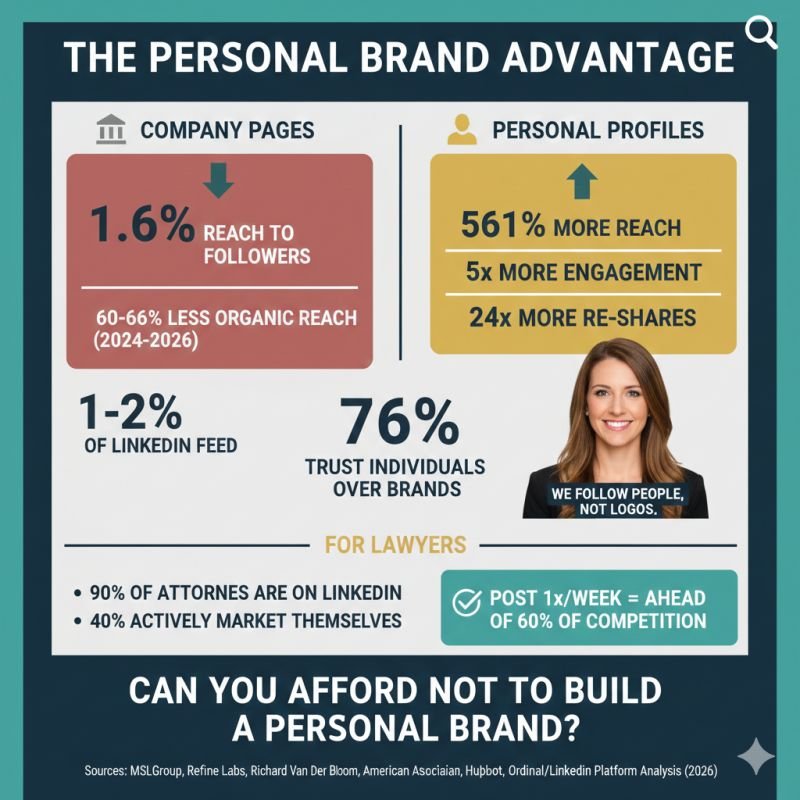
People Follow People, Not Logos
The evidence extends far beyond the legal profession.Cristiano Ronaldo has hundreds of millions more followers than many of the world’s largest football clubs.Entrepreneurs such as Richard Branson and Stephen Bartlett generate dramatically greater engagement than their corporate brands.
The pattern is remarkably consistent.People connect with personalities before they connect with organisations.The same psychology applies to legal services.A prospective client rarely hires a law firm’s logo.They hire the lawyer they trust.
LinkedIn’s Algorithm Has Changed the Rules
LinkedIn increasingly rewards conversations between individuals rather than corporate broadcasting.Recent platform analyses show that personal profiles generally receive significantly higher reach and engagement than company pages.
Several studies suggest:
- Personal posts receive substantially more impressions.
- Employee advocacy often outperforms branded content.
- Educational thought leadership consistently generates stronger engagement than promotional updates.
For lawyers, this creates an opportunity rather than a problem.Instead of relying solely on a firm’s marketing department, individual lawyers can become trusted voices within their practice areas.
Trust Is Built Before Clients Need a Lawyer
Legal services operate differently from many other industries.Most clients do not search for a lawyer every day.They search when something important has already happened.At that moment, familiarity becomes valuable.
If someone has been reading your insights for months, learning from your articles, or watching your commentary on legal developments, much of the trust-building process has already occurred.Your content has been conducting the first consultation long before your first meeting.
Expertise Is More Persuasive Than Self-Promotion
Many lawyers still use LinkedIn primarily to announce awards, promotions, office openings, or internal achievements.While these milestones have value, they rarely answer the question every potential client is asking:
“How does this help me?”
Educational content performs differently.Instead of saying:We won an award.
Explain:
Three legal mistakes business owners should avoid before signing a commercial lease.Instead of announcing a new office, explain what changing regulations mean for local businesses.Teaching consistently creates more credibility than advertising.
Personal Brands Strengthen Firms Rather Than Compete With Them
Some firms hesitate to encourage lawyers to develop personal brands because they worry the firm’s identity will become secondary.In practice, the opposite often happens.Strong personal brands increase visibility for the entire organisation.
Clients discover individual lawyers first and then develop confidence in the broader firm.Rather than competing with the firm’s reputation, personal branding often becomes one of its strongest growth engines.
AI Makes Human Authority Even More Valuable
Artificial intelligence has dramatically reduced the cost of producing content.Articles, newsletters, and social media posts can now be generated within minutes.As information becomes abundant, credibility becomes scarce.Clients no longer struggle to find legal information.
They struggle to identify which lawyer they can trust to interpret it.That makes human judgment increasingly valuable.The future belongs not to lawyers who publish the most content, but to those whose expertise consistently earns attention and confidence.
Building a Personal Brand Doesn’t Require Becoming an Influencer
Many lawyers misunderstand personal branding.It is not about becoming famous.It is about becoming recognisable within a specific area of expertise.One thoughtful LinkedIn post each week.One practical article each month.Consistent engagement with clients and peers.Over time, these small actions compound into professional authority that advertising alone cannot buy.
Conclusion
The legal profession has always been built on trust.Technology has changed how that trust is established but not why it matters.Firm brands remain important.However, increasingly, clients meet the lawyer before they meet the firm.
For that reason, the strongest marketing strategy is no longer choosing between institutional branding and personal branding.It is combining both.Because in the attention economy, people rarely follow logos.They follow people who consistently demonstrate expertise, judgment, and value.
References
- LinkedIn Employee Advocacy research
- MSLGroup Employee Advocacy Study
- HubSpot Marketing Reports
- American Bar Association – Legal Marketing Insights
- Richard van der Blom – LinkedIn Algorithm Reports
- Edelman Trust Barometer
- Why Lawyers Should Build a Personal Brand Before Growing Their Law Firm
- The Follower Advantage: Why Strategic AI Adoption Outperforms Being First
- The First Contact Problem: Why Law Firms Lose Clients Before the Consultation Even Begins
- LinkedIn Articles vs Posts: Why Law Firms Need Both to Build Trust
- Create Client-Focused LinkedIn Content: Why Educational Posts Outperform Self-Promotion